
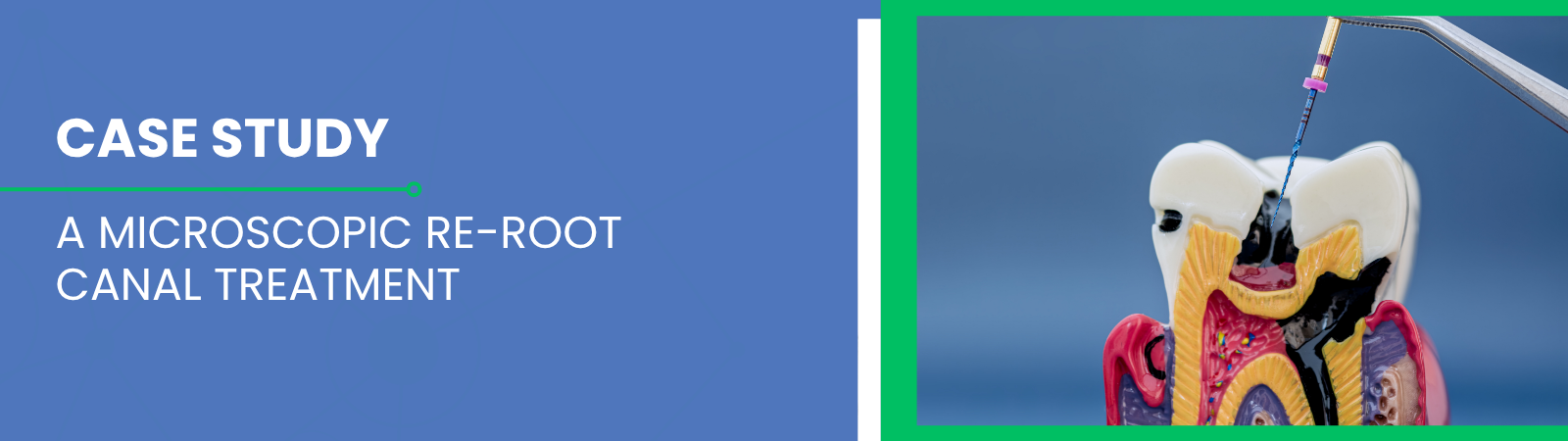
Saving a Hopeless Tooth: A Microscopic Re-Root Canal Treatment
PATIENT PROFILE
Age | 32 years |
Gender | Male |
Occupation | Working Professional (IT) |
City | Bangalore |
Presenting Complaint | Persistent pain and swelling in an upper back tooth that had already been root-canal treated years ago |
Diagnosis | Failed root canal treatment with periapical infection in the upper right first molar |
Duration of Issue | Around 4 months of on-and-off pain, with the last 3 weeks being constant |
Previous Treatments | Root canal done at another clinic about 5 years ago, followed by a crown. Antibiotics taken twice in recent months. |
Date of Procedure | January 2026 |
Outcome | Excellent |
THE PROBLEM
The Condition
The patient came in with a failed root canal in his upper right first molar. In simple terms, a root canal had been done on this tooth a few years ago, but the infection had returned. On the X-ray, we could see a dark shadow at the root tip, which is a clear sign of bacteria still active inside the tooth. The earlier treatment had missed a small extra canal, and the filling inside the roots was short and not properly sealed.
The tooth was tender to bite on, and there was a small bump on the gum above it that drained pus from time to time. Two other dentists had already told him the tooth was “hopeless” and should be removed and replaced with an implant.
Emotional and Psychological Impact
The patient was understandably anxious. He had spent a fair amount of money on the original root canal and crown, and the thought of losing the tooth was upsetting. He was avoiding social lunches at work because chewing on that side hurt, and the recurring swelling made him self-conscious during meetings.
He had also been on antibiotics twice in four months, which he was uncomfortable with. By the time he reached Aspire Dental Clinic, he was tired, frustrated, and looking for a second opinion before agreeing to an extraction. Saving his natural tooth, if at all possible, was his clear preference.
CONSULTATION AND TREATMENT PLAN
What Was Assessed During the Consultation
Dr. Darshit Patel evaluated the tooth thoroughly before recommending any treatment. The aim was to find out whether the tooth could actually be saved, and not just attempt a treatment that would fail again.
- Clinical examination of the tooth, gums, and bite to check for cracks, mobility, and signs of infection
- Existing crown and post inside the tooth, to see if they could be safely removed
- Digital X-ray and a CBCT (3D) scan to map the root anatomy and locate any missed canals
- Bone level around the root to confirm the tooth still had a healthy foundation
- Patient’s overall dental and medical history, including diabetes screening and antibiotic history
- The patient’s main goal: to save the natural tooth and avoid an implant if clinically possible
Why This Procedure Was Chosen
After studying the CBCT, Dr. Darshit Patel found that the original treatment had missed a fourth canal, which is fairly common in upper molars. The infection was being fed by this untreated canal. The bone around the root was still healthy enough to support the tooth, which meant a re-root canal treatment under a dental microscope was a realistic option.
- Microscopic re-root canal treatment was chosen because the missed canal could only be located and cleaned safely under high magnification
- The existing crown and metal post were planned for careful removal, as a fresh, proper seal was needed inside the tooth
- Bio-ceramic sealer was selected over traditional sealers for better sealing and a body-friendly response in the bone
- Extraction and implant were kept as a backup plan, but only if the re-treatment did not work
The patient was given the option of going ahead with an implant straight away, but after a detailed conversation about the chances of saving the tooth, he chose to try the microscopic re-treatment first.
PROCEDURE DETAILS
Step-by-Step Overview
Local anaesthesia given to numb the upper right side
- Rubber dam placed to keep the tooth completely isolated and dry
- Old crown removed in one piece so it could be re-cemented later if suitable
- Metal post inside the tooth carefully loosened and taken out under the microscope
- Old root canal filling material removed from all three known canals
- Fourth canal (MB2) located under high magnification and opened up
- All four canals cleaned, shaped, and disinfected using rotary files and irrigation
- Calcium hydroxide medication placed inside the canals for two weeks to settle the infection
- At the second visit, canals filled three-dimensionally with gutta-percha and bio-ceramic sealer
- Tooth built up with a core filling and the crown re-cemented after a final check
Procedure Facts
| Procedure Parameter | Details |
|---|---|
| Duration | Two visits, around 90 minutes each |
| Anaesthesia | Local anaesthesia |
| Equipment Used | Dental operating microscope, rubber dam, rotary endodontic system |
| Materials Used | Gutta-percha with bio-ceramic sealer |
| Approach | Through the existing tooth opening, after removing the crown and post |
| Intraoperative Complications | None |
| Hospital Stay | Not required. Out-patient procedure. |
POST-OPERATIVE RESULTS
The treatment went smoothly across both visits. The pain settled within the first week, and the small swelling on the gum disappeared by the end of the second week. A follow-up X-ray at three months showed clear healing of the bone around the root tip, which is the strongest sign that the infection has cleared and the tooth is back to a healthy state.
The patient is now able to chew normally on that side, and the original crown was saved and re-cemented, so there was no extra cost for a new crown.
Outcomes at a Glance
Infection Control | ✔ Cleared. No swelling or pus drainage at follow-up. |
Bone Healing | ✔ Clear healing visible on X-ray at 3 months. |
Function Restored | ✔ Normal chewing resumed within 2 weeks. |
Patient Satisfaction | ✔ Very high. Natural tooth saved as hoped. |
Complications | ✔ None reported. |
Recovery | ✔ Smooth and within expected timeline. |
PATIENT FEEDBACK
“Two other dentists had told me the tooth could not be saved and that I would need an implant. Dr. Darshit Patel took time to actually study the scans and explain what had gone wrong the first time. The treatment was painless, and three months on, the tooth feels completely normal. I am glad I went for a second opinion before agreeing to an extraction.”
POST-PROCEDURE CARE AND RECOVERY
Instructions Given to the Patient
- Avoid chewing on the treated side for the first 24 hours
- Take prescribed painkillers only if needed. Antibiotics were not required.
- Brush gently around the tooth and use warm saline rinses for 3 days
- Avoid sticky and very hard foods (nuts, hard candy, ice) for 2 weeks
- Continue regular flossing, with extra care around the crown margin
- Follow-up visits scheduled at 1 week, 3 months, and 6 months
Recovery Timeline
| Timeframe | Clinical Progress & Patient Experience |
|---|---|
| Day 1 to 3 | Mild soreness around the tooth. Normal work activities possible. Soft food preferred. |
| Week 1 to 2 | Pain and swelling settle. Patient resumes chewing on the treated side carefully. |
| Month 1 | First clinical review. Tooth feels normal. No tenderness on biting. |
| Month 3 | Follow-up X-ray. Clear signs of bone healing at the root tip. |
| Month 6 | Final review. Tooth functioning well. Patient discharged from active treatment. |
Frequently Asked Questions
In many cases, a failed root canal can be saved with a re-root canal treatment under an operating microscope, especially when the bone around the root is still healthy. At Aspire Dental Clinic in Bangalore, we use a dental microscope to find and clean canals that were missed the first time. Extraction is suggested only when the tooth is cracked or the bone support is too poor.
The treatment is usually done in two visits of around 90 minutes each, spaced about two weeks apart. The first visit cleans and disinfects the canals, and the second visit seals them. In some cases, a single visit is possible if the infection is small. You can see the full range of treatments on our services page.
The procedure itself is done under local anaesthesia, so the patient does not feel pain during treatment. Mild soreness for a day or two afterwards is normal and settles with simple painkillers. Most patients return to work the next day.
Dr. Darshit Patel is an MDS Endodontist with over 12 years of experience in microscopic endodontics and focuses specifically on saving teeth that have been declared hopeless elsewhere. You can read more about the doctor and the team on the About Aspire Dental page. The clinic uses a dental operating microscope, CBCT imaging, and bio-ceramic sealers, which together give a much higher success rate in difficult cases.
The cost depends on the tooth involved, the complexity of the case, and whether a new crown is needed. At Aspire Dental Clinic, the team shares a clear written estimate after the consultation and CBCT, so the patient knows the full cost before starting treatment.
Disclaimer: This page is for informational purposes and not for promotional use.
