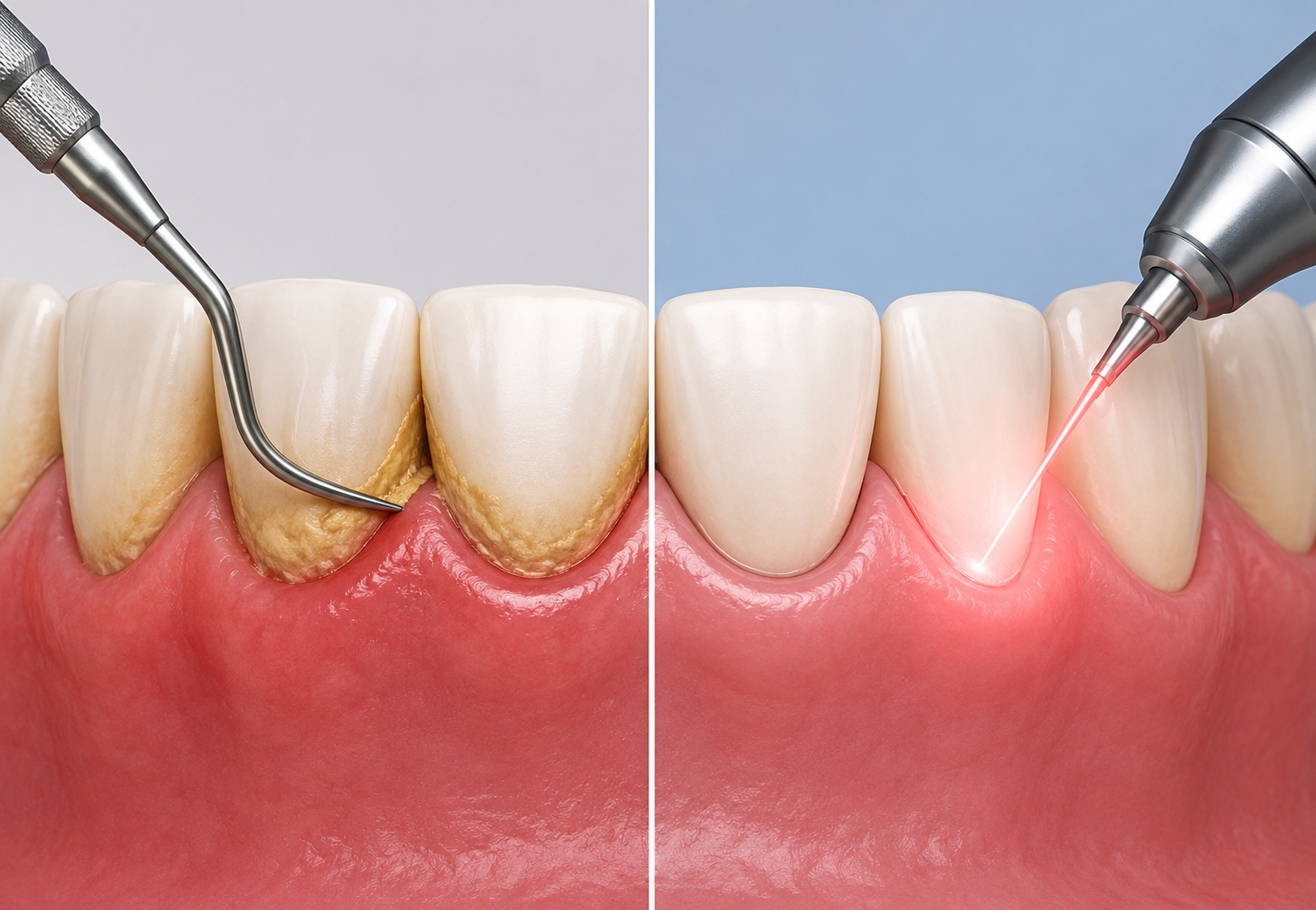
Laser gum treatment and scaling aren’t competing options so much as tools suited to different stages of gum disease. Scaling, or root planing, is the clinical standard for removing tartar and bacterial deposits from below the gum line. Laser therapy works alongside or after scaling to target infected tissue, reduce bacterial load, and support faster healing. Neither replaces the other outright. Which one is better depends on the severity of the disease, how deep the pockets are, and whether the gum tissue has already started to detach from the tooth root.
According to Dr. Madhuri Khoday, a specialist at Dental Clinic in Seegehalli, Bangalore, “Laser therapy doesn’t replace thorough scaling in moderate to severe periodontitis; what it does is reduce residual bacteria and inflamed tissue more precisely than traditional methods, which shortens recovery and improves outcomes in the right cases.”
How Do Laser and Scaling Each Treat Gum Disease?
Both treatments target periodontal disease but work through different mechanisms. Understanding what each actually does helps clarify when one is the better fit.
- Scaling and root planing: is a mechanical process where an ultrasonic scaler and hand instruments physically dislodge calculus and biofilm from tooth roots, reaching several millimetres below the gum line where brushing can’t
- Laser therapy: uses a specific wavelength of light to vaporise infected gum tissue and kill bacteria inside periodontal pockets without physically scraping, which means less bleeding, less trauma to surrounding tissue, and in most cases no sutures
- Combination protocol: is what most periodontists now recommend for moderate cases, where scaling clears the bulk deposit and laser decontaminates the pocket walls and promotes clot formation that supports gum tissue reattachment
- Healing timelines: differ noticeably between the two; patients who undergo laser adjunct therapy typically report less post-procedure soreness and return to normal eating faster than those who had scaling alone on deeper pockets
Scaling addresses the deposit. Laser addresses the environment the deposit created. That’s a meaningful difference in how gum tissue recovers. Laser Gum Disease
When Is Laser the Better Choice Over Scaling Alone?
Laser isn’t always necessary, and for early-stage gingivitis, scaling with good home care is entirely sufficient. But a few clinical situations make laser the stronger option.
- Deep periodontal pockets over 5 mm: respond better to laser adjunct therapy because the light energy can reach areas of the pocket wall that instruments physically struggle to debride thoroughly without damaging the surrounding tissue
- Patients on blood thinners: benefit from laser’s near-bloodless approach since the laser simultaneously seals small blood vessels as it works, reducing the complication risk that conventional scaling carries for this group
- Recurrent gum infections: that return despite repeated scaling sessions often have a bacterial biofilm problem that mechanical cleaning alone can’t resolve, and laser gum treatment disrupts that biofilm at a cellular level
- Gum contouring needs: that arise alongside disease treatment, such as a gummy smile or uneven gum margins, can be corrected with laser in the same session without a separate surgical procedure
So laser isn’t inherently better and scaling isn’t outdated. It all comes down to what’s happening at your gum level what causes receding gums and can it be reversed.
Why Choose Aspire Dental Clinic?
Dr. Madhuri Khoday, MDS Orthodontics and certified Invisalign provider with over 12 years of clinical experience, leads periodontal and laser-based treatment cases at Seegehalli, where pocket depth assessment comes before any gum treatment recommendation. Most post-scaling sensitivity problems trace back to skipping that clinical evaluation entirely.
The protocol at Aspire Dental gets built around the patient’s actual periodontal condition, not a standard cleaning that works on average. That difference is what separates a targeted gum treatment outcome from one that sends patients back with recurring infection.
Dealing with bleeding gums or persistent gum sensitivity and not sure which treatment is right for you?
FAQ
Most patients feel little to no discomfort; local anaesthetic is used when needed.
Mild to moderate cases typically need one to two sessions alongside scaling.
Laser helps but severe cases often need surgical intervention alongside laser therapy.
Bleeding gums need clinical assessment; scaling alone may not address deeper infection.