
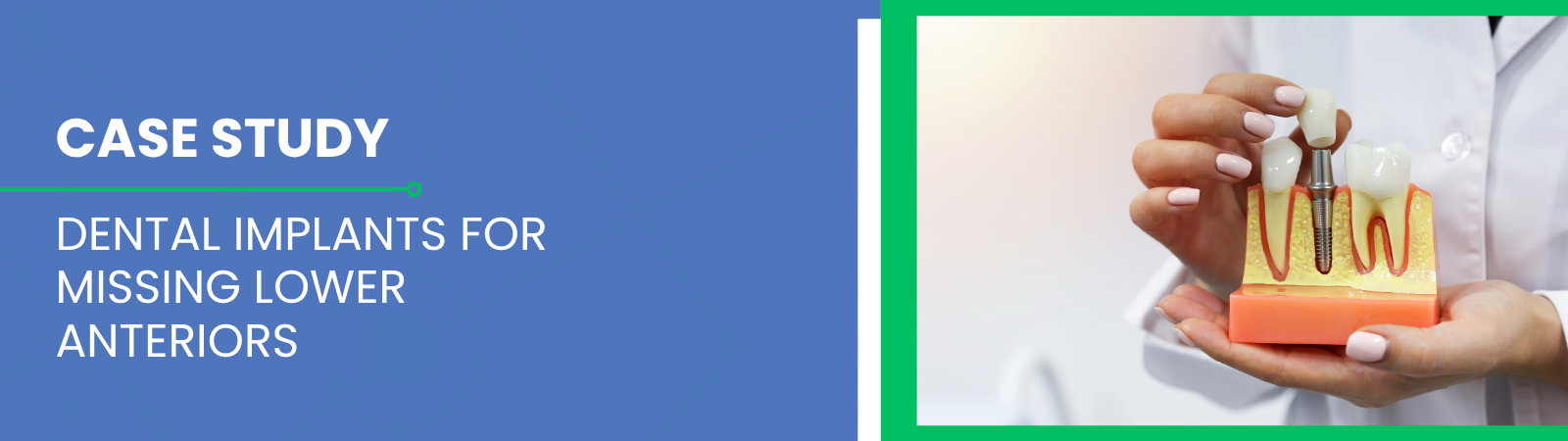
Restoring Form and Function in a Periodontally Compromised Patient with Missing Lower Anteriors
PATIENT PROFILE
| Age | 50 years |
| Gender | Female |
| City | Bangalore |
| Presenting Complaint | Missing lower front teeth and persistent bad breath |
| Clinical Background | Periodontally compromised with severe bone loss across the full dentition |
| Diagnosis | Generalised periodontitis with missing lower anterior teeth |
| Imaging | CBCT and full-mouth clinical periodontal examination |
| Treatment | Full-mouth deep scaling, LANAP laser therapy, dental implant placement for lower anteriors |
| Outcome | Satisfactory restored form and function, improved patient confidence |
THE PROBLEM
Clinical Background
The patient presented to Aspire Dental Clinic, Bangalore with two principal complaints: missing lower front teeth and bad breath of prolonged duration. Clinical examination revealed generalised periodontitis with severe alveolar bone loss affecting the full dentition. Bone destruction in the lower anterior region had already resulted in tooth loss, leaving an aesthetic and functional deficit affecting daily life and confidence.
Bad breath in this context was not a hygiene issue but a direct consequence of the active periodontal infection. Deep periodontal pockets harbouring anaerobic bacteria produce volatile sulphur compounds. Until pocket depth and bacterial load are addressed, halitosis cannot be sustainably resolved.
Why Treatment Sequence Matters
In active generalised periodontitis, dental implant placement cannot safely precede disease control. Placing implants into an infected environment significantly increases peri-implantitis risk and early implant failure. The treatment plan was therefore structured in two phases: first, arrest the disease; second, restore the missing teeth once periodontal stability was confirmed.
Diagnosis
A full-mouth periodontal examination was performed probing depths, furcation involvement, and tooth mobility recorded across all sites. CBCT imaging assessed the three-dimensional extent of bone loss, residual bone volume at implant sites, and proximity to anatomical structures including the mental foramina.
Key findings:
- Generalised moderate-to-severe horizontal bone loss across the majority of the dentition
- Severe bone loss in the lower anterior region, consistent with documented tooth loss at those sites
- Multiple deep periodontal pockets (>6 mm) across posterior quadrants
- Adequate residual bone height and width at lower anterior implant sites to support placement following disease control
Treatment Plan and Execution
Phase 1 Periodontal Disease Control
Full-mouth deep scaling (scaling and root planing) was carried out under local anaesthesia, quadrant by quadrant, to remove supra- and subgingival calculus and disrupt the biofilm driving the infection.
Following deep scaling, LANAP (Laser-Assisted New Attachment Procedure) was performed across the full dentition. LANAP uses a Nd:YAG laser wavelength that selectively targets periodontal pathogens and diseased sulcular epithelium while leaving healthy tissue intact. Laser energy stimulates coagulation along the pocket wall, forming a fibrin clot that supports new connective tissue attachment and, in suitable cases, alveolar bone regeneration. No incisions. No sutures.
Periodontal stability was reassessed at 6–8 weeks post-LANAP. Probing depths, bleeding on probing, and gingival inflammation scores were recorded before proceeding to Phase 2.
Phase 2 Implant Placement for Missing Lower Anteriors
Once stability was confirmed, dental implants were placed at the missing lower anterior sites. CBCT data guided implant position, angulation, and dimensions to achieve primary stability while avoiding anatomical hazards. Implant-supported crowns were subsequently fabricated, completing the aesthetic and functional reconstruction of the anterior region.
Treatment Summary
| Condition Treated | Generalised periodontitis with severe bone loss; missing lower anterior teeth |
| Imaging Used | CBCT + full-mouth clinical periodontal examination |
| Phase 1 — Periodontal | Full-mouth deep scaling (scaling and root planing) + LANAP laser therapy |
| Phase 2 — Restorative | Dental implants for missing lower anterior teeth |
| Anaesthesia | Local anaesthesia |
| Key Technology | PerioLase LANAP laser, CBCT, implant surgery kit |
| Outcome | Disease arrested; missing teeth replaced; aesthetics and function restored |
| Follow-Up Protocol | Regular periodontal maintenance to protect implant longevity |
PATIENT FEEDBACK
I had severe gum problems and had already lost my lower front teeth. When I came to Aspire Dental Clinic, I was worried the bone loss would mean implants weren’t possible for me. The team did a detailed scan and examination and gave me a proper treatment plan gum treatment first, implants only after. The laser therapy was nothing like I expected. No surgery feel to it at all. When they confirmed the gums were stable and proceeded with the implants, I felt the whole process had been handled very carefully and professionally. The results speak for themselves. My teeth look natural, I can bite properly, and I no longer have that persistent bad smell I was so self-conscious about.
Post-Treatment Results
Following both treatment phases, the periodontal condition was clinically stable under the care of Dr. Madhuri Khoday. Pocket depths had reduced, bleeding on probing was substantially decreased, and the source of pathological halitosis the deep infected pockets had been eliminated. The patient reported complete resolution of bad breath.
The implant-supported restorations closed the aesthetic deficit affecting the patient’s confidence and re-established normal phonetics and anterior biting function.
Outcomes at a Glance
| Outcome | Status | Notes |
| Periodontal Disease Arrested | ✔ Achieved | Pocket reduction confirmed at reassessment |
| Bone Loss Progression Stopped | ✔ Achieved | LANAP arrested active destruction |
| Bad Breath Resolved | ✔ Achieved | Pathological halitosis eliminated at source |
| Missing Teeth Replaced | ✔ Achieved | Implant-supported crowns in lower anterior region |
| Aesthetics Restored | ✔ Achieved | Anterior smile line re-established |
| Function Restored | ✔ Achieved | Normal biting and phonetics |
| Patient Confidence | ✔ Improved | Reported by patient at review |
Post-Treatment Care and Follow-Up Protocol
- Professional periodontal maintenance every 3–6 months, including implant review
- Twice-daily brushing with a soft-bristle toothbrush; interdental brushes around implant crowns
- Tobacco avoidance significantly increases peri-implantitis risk in periodontally susceptible patients
- Annual radiographic review to monitor bone levels around implants
- Immediate presentation if mobility, pain, or swelling occurs around any implant site
Frequently Asked Questions
Yes. Severe periodontitis destroys the bone and connective tissue anchoring teeth. Without treatment, progressive bone loss leads to tooth mobility and eventual tooth loss. Early intervention is critical.
LANAP uses a specific wavelength laser to selectively destroy periodontal pathogens and diseased tissue while preserving healthy gum tissue. Unlike traditional flap surgery, LANAP involves no cutting or sutures, causes minimal postoperative discomfort, and promotes regeneration of the attachment between gum and bone.
attempt.
Yes, but only after the gum disease has been treated and periodontal stability confirmed. Active periodontitis significantly increases implant failure risk. Once the infection is controlled and bone levels are stable, implants can be placed successfully with appropriate monitoring.
Bad breath in periodontitis results from volatile sulphur compounds produced by anaerobic bacteria in deep periodontal pockets. Eliminating the bacterial load through scaling and LANAP resolves pathological halitosis at its source.
With regular periodontal maintenance every 3–6 months and diligent home care, implants in periodontally susceptible patients can last 15 to 20 years or more. Compliance with follow-up is the single most important factor in long-term implant survival.
