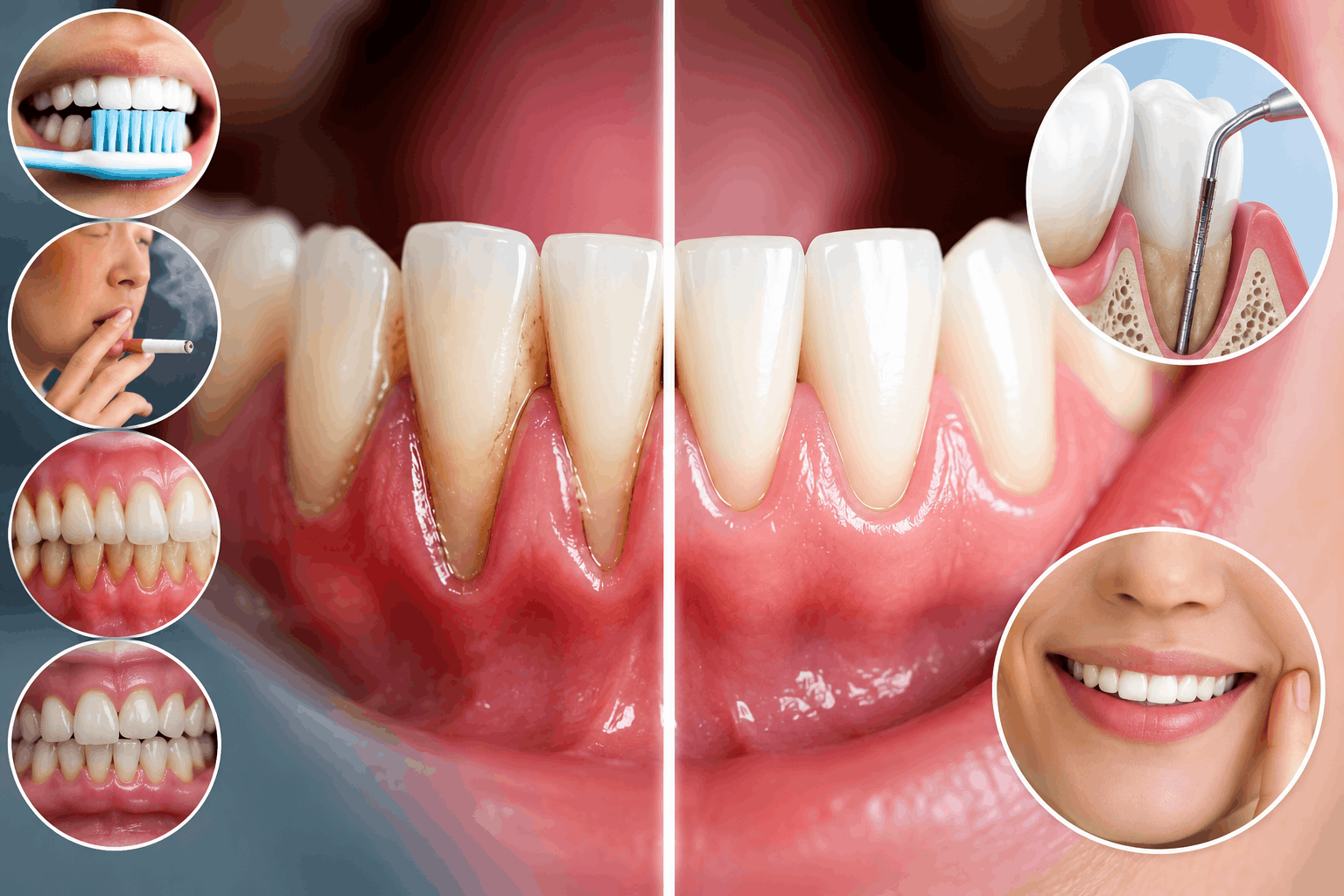
Receding gums occur when gingival tissue pulls away from the tooth surface, exposing the root below the cementoenamel junction. Periodontitis is the leading cause, though aggressive brushing, bruxism, thin gum biotype, and hormonal shifts all contribute independently. Lost gum tissue doesn’t regenerate on its own, but recession can be stopped and surgically corrected depending on how far it has progressed.
According to Dr. Madhuri Khoday, a specialist at Dental Clinic in Seegehalli, Bangalore, “patients often don’t realise their gums are receding because there’s no pain until the root surface is significantly exposed and sensitivity sets in.”
What Actually Causes Gum Recession?
Recession rarely has a single cause. Several distinct mechanisms drive gingival tissue apically, and identifying which one applies determines what treatment will work.
Periodontitis: Bacterial plaque hardens into calculus below the gumline, triggering chronic inflammation that destroys both soft tissue and alveolar bone, pulling the gingival margin progressively downward as the supporting structure beneath it collapses.
Aggressive brushing: Scrubbing with a hard-bristled brush or using excessive horizontal force physically abrades gum tissue over months and years, creating the characteristic notched recession pattern most visible on premolar and canine surfaces.
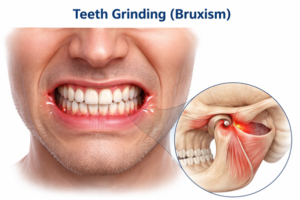
Bruxism: The lateral forces generated during grinding concentrate stress on the bone and gum tissue surrounding individual teeth, and that mechanical trauma compounds over time in ways that aren’t always obvious until recession is already moderate. For a broader look at how grinding damages oral structures, our blog on teeth grinding and bruxism covers the full picture.
Thin biotype: Some patients are simply born with a delicate gingival architecture that makes recession more likely under any of the above conditions, even with careful oral hygiene.
Recession caused by active infection won’t stabilise until the bacterial load is controlled. Without that step, no surgical correction holds.
Can Receding Gums Be Reversed, and What Are the Options?
Gum tissue that’s already been lost doesn’t grow back spontaneously. But that doesn’t mean nothing can be done.
Early recession: Removing the cause stops further loss. Switch to a soft brush, correct the technique, treat active gum disease with scaling and root planing, and the remaining tissue can be maintained indefinitely without surgery.
Laser gum treatment: Where active infection is driving recession, laser therapy cleans periodontal pockets with far less bleeding and post-operative discomfort than conventional flap surgery, and it supports faster tissue healing around the treated roots.
Gum grafting: A connective tissue graft taken from the palate is placed over the exposed root surface, integrating with existing tissue to re-establish a proper gingival seal. It’s the most predictable surgical option for covering recession that has already progressed.
Dental crowns: Where prolonged exposure has allowed root decay or structural damage to develop alongside the recession, a dental crown stabilises the tooth before or after a graft procedure, and that sequencing matters clinically.
Most patients who come in at an early stage need no surgery at all. That window closes faster than most people expect.
Why Choose Dr. Madhuri Khoday at Aspire Dental Clinic?
Dr. Madhuri Khoday holds an MDS in Orthodontics and Dentofacial Orthopedics from KLE Institute of Dental Sciences and is a certified Invisalign provider with over 12 years of clinical experience in specialist dentistry. She leads gum health evaluations at Aspire Dental Clinic, working alongside Dr. Darshit Patel, MDS Endodontics and Certified Implantologist, to coordinate periodontal, restorative, and orthodontic care under one roof.
Patients with moderate to advanced recession who’ve been told to “wait and see” elsewhere consistently leave with a clear surgical or non-surgical plan after their first consultation here.
FAQ
Lost tissue doesn’t regenerate naturally, but surgical grafting can cover exposed roots effectively.
No. Early recession caught in time is managed by removing the cause and treating infection non-surgically.
Yes. Repeated mechanical trauma from aggressive brushing causes irreversible tissue loss over time.
Not necessarily. Untreated advanced recession with bone loss increases that risk, but early treatment prevents it.